




One-piece housing machined from a solid block of 6061-T6 aircraft-grade aluminum
Large 28mm dia. micro-etched glass flat, moving & fixed reticles (no fragile spider webs to break)
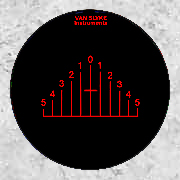
NEW custom designed reticle pattern with 10 micron ultra-fine lines (see pattern at right)
NEW GIANT 1.15" diameter Mitutoyo micrometer head (made in Japan, not China)
NEW 25mm (1.25" format) Plossl Multi-Coated eyepiece with quick push/pull reticle focusing
NEW LCD digital indicator with 50/millionths of an inch resolution (included, was $600 option)
Analog dial indicator with indices of 0.001" (easy interpolation to 0.0001")
NEW PA retaining ring holds BFM even when inverted and rotating PA dial
Built-in Rigel Systems PulsGuide illuminated reticle w/variable pulse width
Internal moving reticle table/stage with NEW thumb screw lock-down
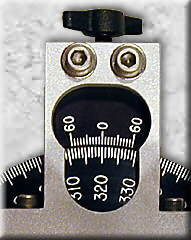
NEW Aluminum CNC Laser-Cut 4" diameter position angle indicator w/1 degree indices
NEW Aluminum CNC Laser-Cut 1/10th degree Vernier scale (included, was $200 option)
Removable Barlow offers two different magnifications (25mm=1X, 12mm=2X)
NEW All Stainless Steel hardware
Aircraft-grade 6060-T6 aluminum (NAS620 or AN960 aeronautics specs) or better
Military specification 18-8 stainless steel (MS15795, MS27183 or ASTM A693) or better
Positive, zero reticle backlash/shift, spring-loaded ball bearing reticle table/stage movement
2" format barrel-nose with safety 10 degree flange cut (circular dovetail)
Reticle line thickness = 0.0005" (10 microns)
Dimensions (BFM housing) = 3.5" x 2" x 1.25"
Weight = 1 lb. 13 ozs.

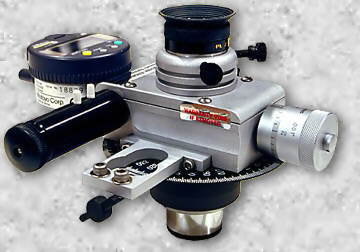
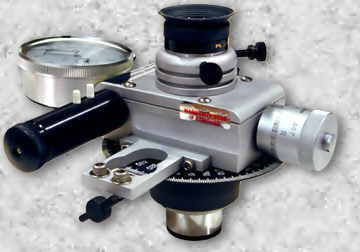
 Pictured above are ultra high precision
analog and digital bifilar micrometer (BFM) assemblies for professional level
astrometric research projects. The NEEDLEYE BFMs are capable of providing
repeatable measurements with sub arc-second accuracy. These instruments are
equipped with Mitutoyo (made in Japan, not China) micrometer heads. Analog
models feature an easy-to-read analog (0.001" indices) dial indicator (above
right) or Digital LCD (0.00005"/0.001mm) electronic indicator (above left).
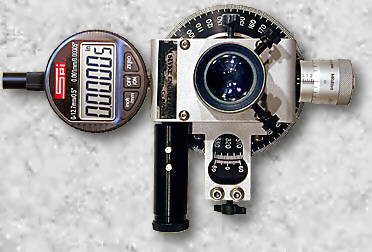
Both models include a 4-inch diameter position angle dial with 1/10th degree
Vernier scale (pictured at left and below), and a 25mm Plossl Multi-Coated
eyepiece with incorporated Barlow behind the fixed and moving reticles (see
below for more info).
Pictured above are ultra high precision
analog and digital bifilar micrometer (BFM) assemblies for professional level
astrometric research projects. The NEEDLEYE BFMs are capable of providing
repeatable measurements with sub arc-second accuracy. These instruments are
equipped with Mitutoyo (made in Japan, not China) micrometer heads. Analog
models feature an easy-to-read analog (0.001" indices) dial indicator (above
right) or Digital LCD (0.00005"/0.001mm) electronic indicator (above left).
Both models include a 4-inch diameter position angle dial with 1/10th degree
Vernier scale (pictured at left and below), and a 25mm Plossl Multi-Coated
eyepiece with incorporated Barlow behind the fixed and moving reticles (see
below for more info).
All digital BFMs are equipped with an SPI LCD digital indicator with large 0.5" readout and 0.00005"/0.001mm resolution (see picture at left) as standard equipment. That's 50/millionths of an inch! This special digital indicator is Certified and traceable to NIST (National Institute of Standards). It is also an absolute encoder, which means that the readings are maintained for the life of the battery, even when the power is off. The digital readout is also immune to overspeed errors and has an approximate 20,000 hour battery life.
The unique 2x removable Barlow lens (shown below right, black ring at bottom of 1.25" diameter barrel) provides the magnification of the standard 25mm Plossl eyepiece (removed) or a 12mm eyepiece (installed). This optical principle is similar to the hi-end Nagler eyepieces offered by Televue that have an incorporated Barlow behind the eyepiece to provide better eye relief and wider fields of view at higher magnifications. Basically, higher magnifications are achieved while maintaining the exceptional eye relief of the lower power 25mm eyepiece - an exclusive VSI feature.
 The NEEDLEYE housing is machine milled
from a solid 6061-T6 aircraft-grade aluminum block. Internally, the moving
reticle table is [also] machined from a solid block [same grade] aluminum
and is mounted in a spring loaded ball bearing flotation assembly providing
zero reticle backlash/shift. The housing and internal moving table are bench
tested to high industry standards of fifty/millionths of an inch. NEEDLEYE
BFM's contain military-quality, optical-grade, micro-etched glass, moving
and fixed reticles (no strings attached). All models include built-in Rigel
Systems PulsGuide variable pulse and illumination system (black cylinder).
BFM box dimensions are 3.5" x 2" x 1.25". Weight = 1.8 lbs. All metal
construction.
The NEEDLEYE housing is machine milled
from a solid 6061-T6 aircraft-grade aluminum block. Internally, the moving
reticle table is [also] machined from a solid block [same grade] aluminum
and is mounted in a spring loaded ball bearing flotation assembly providing
zero reticle backlash/shift. The housing and internal moving table are bench
tested to high industry standards of fifty/millionths of an inch. NEEDLEYE
BFM's contain military-quality, optical-grade, micro-etched glass, moving
and fixed reticles (no strings attached). All models include built-in Rigel
Systems PulsGuide variable pulse and illumination system (black cylinder).
BFM box dimensions are 3.5" x 2" x 1.25". Weight = 1.8 lbs. All metal
construction.
NOTE: The 1.25" extension at the bottom of the BFM could be marginally inserted in a 1.25" format focuser. However, this short 1.25" Barlow barrel simply extends the Barlow lens to its proper distance from the eyepiece, and is not intended as a docking fixture (VSI accepts no responsibility for accidents). Also, you would not have use of the Position Angle indicator dial since it is directly attached to the rotating 2" format ring, not the fixed 1.25" Barlow extension barrel.
IMPORTANT FEATURE: Since the 2x Barlow magnification occurs before the image reaches the reticles and 25mm eyepiece, the reticle lines appear much smaller than with other illuminated reticle devices without integral Barlow lenses. This is because the lines are only being magnified with the 25mm eyepiece, not the Barlow lens, which is on the opposite [sky] side of the reticles from the eyepiece.
RECOMMENDATION: If you must use a [2" format] diagonal, in conjunction with the BFM, use a mirror-type diagonal, not a prism-type. Mirror-type diagonals offer the most reflectivity, highest resolution, brightest and sharpest image possible, compared to prism-type diagonals. Before first-surface mirror flats were offered in ultra-high [1/10th wavelength or better] surface accuracies, prisms were extensively used in diagonals because they were easily mass-produced for binocular image-erecting applications and they were very cheap to simply "drop-in" a diagonal. Many decades ago, because of [hype] advertising touting prisms over mirrors, people thought prisms were better than mirrors, and many of them probably were back then, but not anymore! Old obsolete misinformation. Think about it. Prisms have three surfaces, instead of one like a first-surface mirror - 1) entering the glass prism, 2) reflecting off the hypotenuse of the prism (which should be silvered for maximum reflectivity, but usually isn't), and 3) exiting the prism. That's three optical surfaces your image has to traverse, compared to only one with a mirror. Image degradation is three times that of a mirror. During this intrinsic excursion, your image is traveling through pure glass, which reduced image brightness, simply because of the microscopic impurities in the glass itself, and the much higher density of the medium compared to "nothing at all." - PBVS
![[return to home]](bareturn.jpg)
![[top of the page]](topage.jpg)